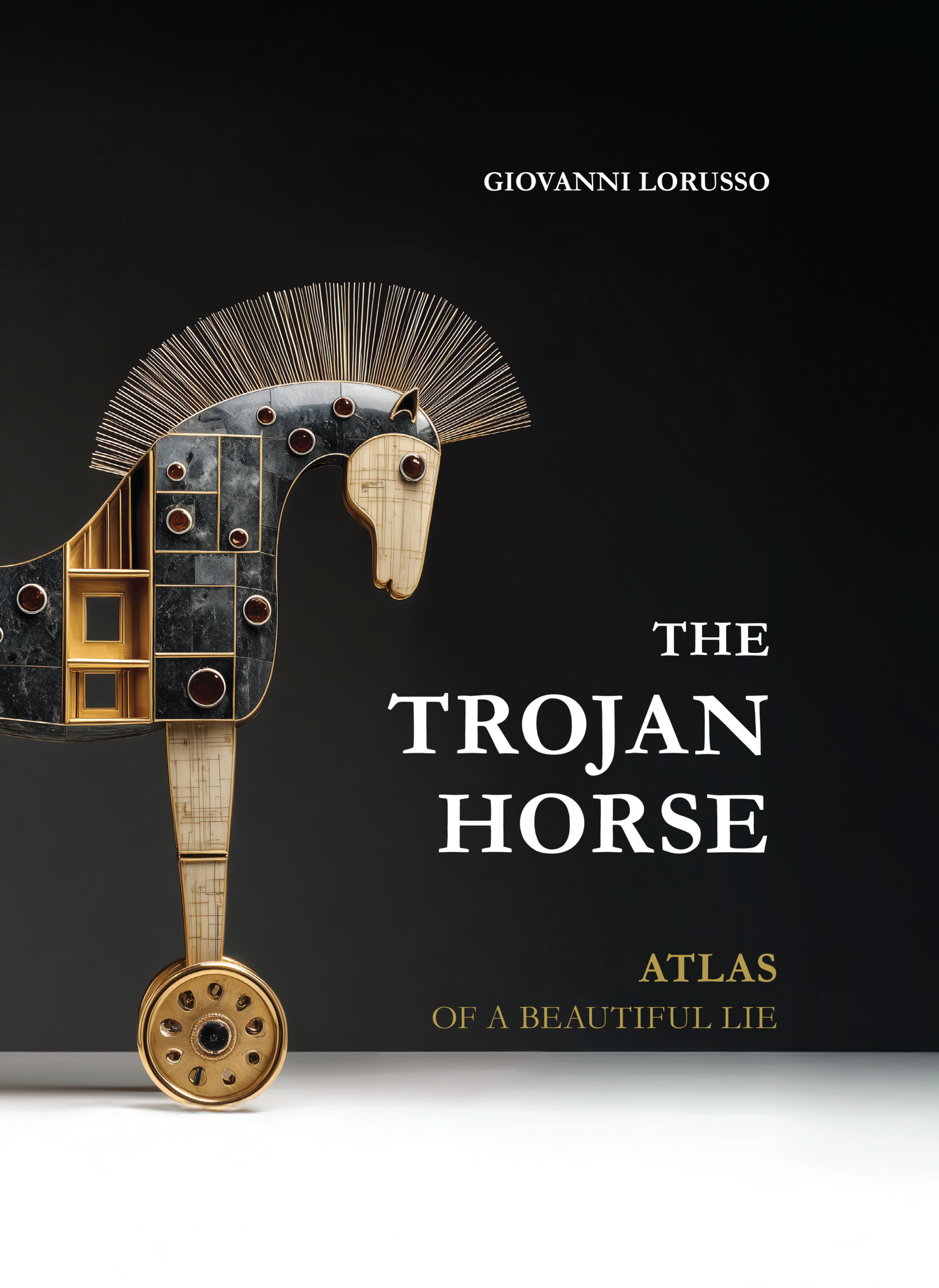
the Trojan Horse crosses architecture, cities, images and cultural heritage. A horse enters history as a machine of deception and emerges transformed into a universal image. The Trojan Horse. Atlas of the Beautiful Lie crosses centuries of copies, reinventions and visual metamorphoses to examine how an object whose appearance has never been known with certainty became one of the most recognisable forms in the Western imagination. A visual atlas spanning archaeology, art, cinema, popular culture and contemporary imagery. In the volume, GIOVANNI LORUSSO develops the narrative from the material substance and images of its subject. The book is part of the Metamorfosi visive series published by Varchi Books.
The Trojan Horse is one of the most celebrated images in Western history. Yet no one can say with certainty what form it took, whether it truly existed or what object lies behind the story handed down by ancient sources. Its figure seems familiar precisely because, for centuries, we have continued to invent it.
The Trojan Horse. Atlas of the Beautiful Lie emerges from this contradiction. The volume does not seek a definitive reconstruction of the horse, nor does it propose a new archaeological solution. Instead, it examines what happened to the image: the ways in which painters, engravers, illustrators, archaeologists, set designers, film-makers, advertisers and producers of visual culture have repeatedly given a different body to an object that has remained without a certain form.
Every age has constructed its own horse. At times it is a plausible war machine; at others, a large sculpture, a wooden animal, a mobile architecture, a monumental presence or an almost mechanical device. Its proportions change, as do the imagined materials, the warriors’ means of access and its relationship with the walls of Troy. What remains constant is the need to make it visible.
The atlas brings archaeology, art, illustration, cinema and popular culture into relation, following the transformations of a figure consolidated through repetition. Images do not merely recount the legend: they ultimately alter its memory. A form seen many times becomes familiar; familiarity produces recognition; recognition can be mistaken for authenticity.
The book traces this process without rigidly separating high culture from mass culture. An ancient vase, a painting, an illustrated plate, a film set or a contemporary image may all take part in the same long visual construction. Placed alongside one another, they reveal not a single horse, but a genealogy of possible horses.
The Trojan Horse. Atlas of the Beautiful Lie is therefore a book about the form of a legend, but also about the power of images. About how what we do not know can become recognisable. About how copying, variation and repetition can give substance to an absence until it becomes one of the most persistent images in the Western imagination.