Does the Trojan Horse Appear in the Iliad or the Odyssey?
The Horse does not conclude the Iliad: it is recalled in the Odyssey and in the lost poems of the Epic Cycle. Here is where it appears and why the confusion persists.
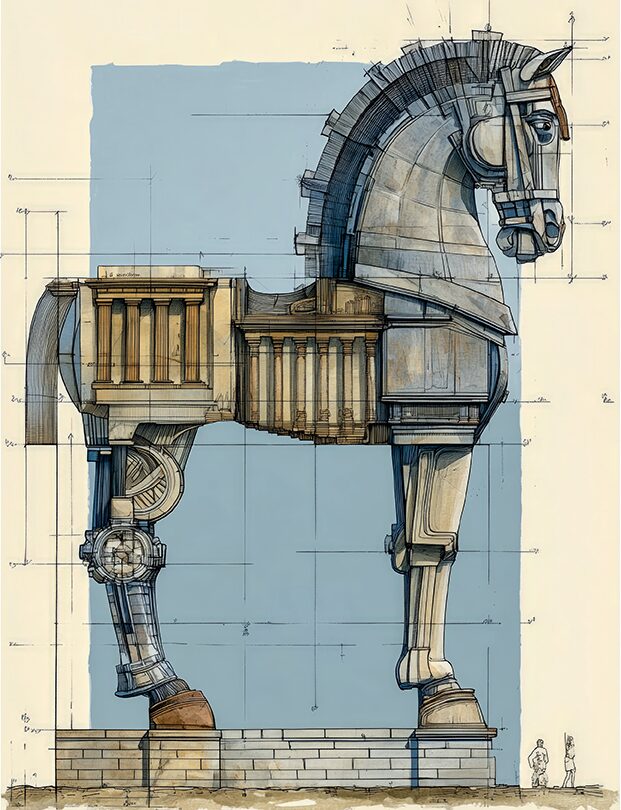
The Trojan Horse belongs to the Homeric imagination, but it does not appear where many readers expect it. The Iliad does not narrate the construction of the Horse, its entry into the city or the night of Troy’s destruction. The poem ends earlier, with the return of Hector’s body to Priam and the funeral of the Trojan hero.
The question ‘Does the Trojan Horse appear in the Iliad or the Odyssey?’ concerns more than a schoolroom detail. It reveals how an epic tradition is formed, how different narratives merge in collective memory and how an image may become more famous than the text that contains it.
The essential answer
The Trojan Horse is not narrated in the Iliad. It appears in the Odyssey, where it is recalled in several passages, especially in Book VIII. Demodocus, the Phaeacian bard, sings of the construction of the wooden Horse, made by Epeius with Athena’s assistance and brought by Odysseus into the Trojan citadel after it had been filled with Achaean warriors.
The Odyssey, however, does not offer a single continuous account resembling the version familiar to many readers. The episode appears through memories, songs and references. The fuller version that became especially influential in European culture was written centuries later by Virgil in Book II of the Aeneid.
Where the Iliad actually ends
The Iliad narrates a limited portion of the Trojan War. Its centre is not the entire conflict, but the anger of Achilles and the consequences that anger produces in the Achaean camp and the besieged city.
The poem opens when the war has already lasted for years. It does not narrate the abduction or departure of Helen, the sailing of the Greek fleet or the beginning of the siege. Nor does it reach the death of Achilles, the building of the Horse or the fall of Troy.
Its ending belongs to Hector. Priam enters Achilles’ shelter, recovers the body of his son and returns to the city. The Trojans hold the funeral. The war continues beyond the final line, but the poem has completed its form: anger has become recognition of another person’s grief.
Why everyone associates the Horse with the Iliad
In ordinary speech, ‘the Iliad’ is often used as a name for the entire Trojan War. Films, summaries, schoolbooks, illustrations and children’s retellings compress ten years of conflict into a single sequence. Achilles, Hector, the Horse and the burning city then seem to belong to one text.
The force of the title contributes to the confusion. The Iliad is the poem of Ilios, or Troy, so it appears natural to assign everything connected with the city to it. Yet a work may take its name from a place without narrating every event associated with that place.
Cultural memory does not always preserve bibliographical boundaries. It preserves scenes. The duel between Achilles and Hector, the Horse drawn through the gates and the escape of Aeneas come to inhabit a single visual archive.
The Horse in Book VIII of the Odyssey
In Book VIII, Odysseus is at the court of the Phaeacians and has not yet fully revealed his identity. During a feast, he listens to Demodocus sing episodes from the Trojan War and reacts with an emotion he attempts to conceal.
He eventually asks the bard to change the subject and sing of the construction of the wooden Horse. The text attributes the work to Epeius, assisted by Athena, and recalls that Odysseus brought it by stratagem into the citadel after filling it with the men who would destroy Troy.
The bard’s song begins when some of the Achaeans burn their tents and sail away, while the others wait hidden within the Horse. The Trojans debate what to do with the object and finally choose the decision that leads to their destruction.
The scene matters because the Horse does not appear merely as an external fact. It is sung before Odysseus, one of its protagonists. Myth becomes a memory heard by the man who lived it.
Odysseus listens to his own legend
Odysseus’ tears during the songs of Demodocus reveal a central tension in the Odyssey. The hero has already become poetic material before he has returned home. He hears his own war transformed into public narrative.
The same distance affects the Horse. For the Phaeacian community it is a glorious episode. For Odysseus it contains companions, fear, destruction and a city in flames. The heroic form of song does not remove the personal cost of memory.
The Odyssey therefore suggests that myth does not arise only after events are over. It begins while the participants are still alive and must recognise themselves in the images others produce of them.
Epeius builds, Odysseus devises
The Odyssey presents Epeius as the maker of the Horse and associates Athena with its construction. Odysseus is the figure who brings the object into the citadel by deception. Other traditions make the distinction between strategic invention and technical work even more explicit.
Summaries of the Little Iliad, one of the lost poems of the Epic Cycle, attribute inspiration for the plan to Athena and the construction to Epeius. The material survives through fragments and later testimony, not through a complete text comparable to the Iliad or the Odyssey.
The Horse therefore emerges from at least three functions: the strategic intelligence of Odysseus, the technical skill of Epeius and the divine support of Athena. The machine of deception is at once idea, project and construction.
The Epic Cycle and the lost narratives
The Iliad and the Odyssey are the most famous works of the Trojan tradition, but they were not the only ones. Other poems narrated the causes of the war, events after Hector’s death, the fall of the city and the returns of the heroes.
The Little Iliad and the Iliou Persis, now almost entirely lost, included episodes concerning the Horse and the destruction of Troy. What we know comes from fragments, summaries and quotations preserved by later writers.
This loss changes our perception. The Horse may appear to be a marginal addition to the Homeric poems, while in fact it belonged to a much wider narrative system. Epic tradition functioned as a constellation of connected stories rather than a single definitive book.
The Aeneid and the version we remember
Many details commonly associated with the Horse come from Book II of the Aeneid. Aeneas recounts the fall of Troy at the court of Dido: the Horse left on the shore, the false Greek withdrawal, Sinon’s story, Laocoön’s warning, the entry of the object and its opening at night.
Virgil organises the episode from the perspective of the defeated. Readers know the outcome, yet follow the construction of the deception’s credibility. The Horse does not enter because no one suspects it. It enters because warnings are overwhelmed by a more persuasive narrative and by signs interpreted as divine will.
The literary force of the Aeneid profoundly influenced painting, theatre, education and cinema. Many modern representations of the Horse derive more from Virgil’s narrative structure than from Homer’s brief references.
Odyssey, memory and embedded narrative
In the Odyssey, the Horse is recalled within a poem of homecoming. It is not only the machine that ends the war. It is part of the identity Odysseus must carry with him.
The poem frequently uses embedded narratives: characters tell, sing, remember and reinterpret events. The story of the Horse passes through this structure. It reaches the reader not as direct chronicle, but as an account already transformed by memory.
This makes the question ‘Iliad or Odyssey?’ more significant. The Horse appears in the poem of return because return cannot be separated from the war that made it necessary.
Why the distinction changes the myth
Assigning the Horse to the Iliad makes it seem like the natural conclusion of the story of Achilles and Hector. Placing it in the Odyssey instead highlights the distance between war and memory, action and narrative, lived identity and sung identity.
The Iliad remains open upon the war. The Odyssey looks backwards from the perspective of a man attempting to return. The Horse stands precisely within this passage: it is the final great stratagem of the war and the burden accompanying the hero home.
Correct textual location is therefore not pedantry. It shows that myth changes meaning according to the narrative that contains it.
From text to collective image
Visual culture has partly erased the distinction between the poems. The Horse appears on covers of the Iliad, in films about the Trojan War and in illustrations that compress the whole cycle into one scene.
The image has synthetic power. A giant Horse before the walls immediately communicates siege, deception and destruction. It is therefore used even when the represented text does not contain it.
Over time, the icon has become stronger than source precision. The Horse became the symbol of the entire war, while the entire war was often reduced to the Iliad.
A form living between different texts
The Trojan Horse — Atlas of a Beautiful Lie begins from the mobility of this figure. The volume does not treat the Horse as an object fixed once and for all, but as a form travelling through texts, images, periods and techniques.
Its persistence also depends on the plurality of sources. The Horse does not belong to a single author or version. Homer recalls it in the Odyssey; the lost poems of the Epic Cycle developed its construction and the fall of Troy; Virgil gave it one of its most influential narrative forms.
Each passage adds something and leaves something else in shadow. Tradition preserves no pure original. It preserves a series of transformations.
The final answer
The Trojan Horse does not appear as a narrated episode in the Iliad. It is recalled in the Odyssey, especially in Book VIII, and was also narrated in lost works of the Epic Cycle. The fullest version best known in European culture appears in Book II of the Aeneid.
The confusion arises because ‘the Iliad’ has become, in ordinary language, a name for the entire Trojan War. The texts, however, preserve different boundaries. Recognising them allows us to see how myth does not belong to a single book: it passes from one voice to another, changes perspective and continues to generate images.
Essential verified sources
- Homer, Iliad, Book XXIV.
- Homer, Odyssey, Book VIII, especially approximately lines 492–520.
- Fragments and summaries of the Epic Cycle, including the Little Iliad and Iliou Persis.
- Virgil, Aeneid, Book II.
- Varchi Books, The Trojan Horse — Atlas of a Beautiful Lie.
Continue through the editorial areas
Places and Heritage
Cities, monuments, historic centres and cultural landscapes read as living bodies.
Open editorial areaTerritories and Society
Southern Italy, internal areas, work, school, departures and the right to permanence.
Open editorial areaCare, Family and Recognition
Invisible labour, families, care, generations and forms of recognition.
Open editorial areaMyth, Archaeology and Images
Ancient narratives, visual cultures, myths, deception and the afterlife of images.
Open editorial area