Sinon and the Art of Making a Lie Credible
An article on Sinon, the Trojan Horse and the rhetorical construction of a credible lie.
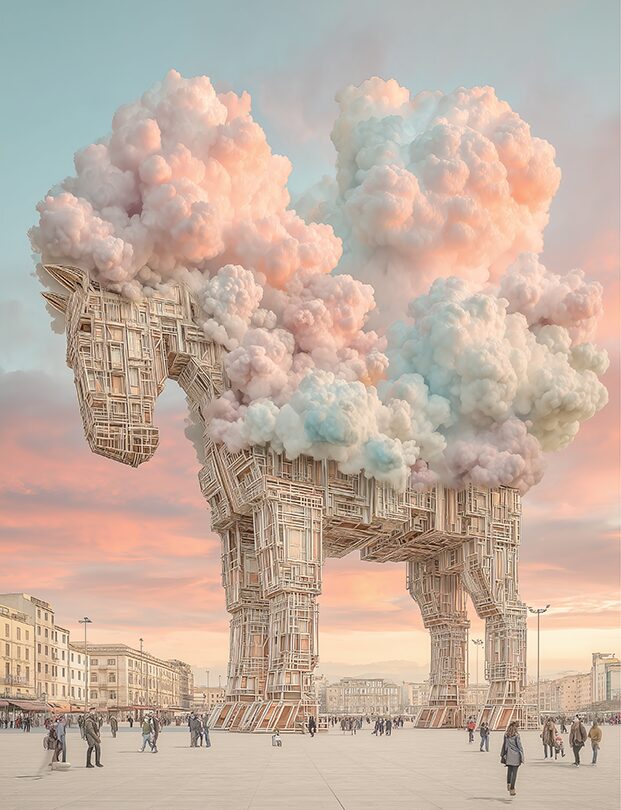
Sinon does not build the Trojan Horse, design it or command the warriors hidden inside. Yet without him the deception would probably fail. His task is to give the object a credible story.
In Book II of the Aeneid, Sinon is left on the shore after the Achaeans’ feigned departure. He presents himself to the Trojans as a victim of his own companions and transforms the Horse from a suspicious object into a sacred offering. His lie works because it does more than ask to be believed: it organises fears, desires and signs already present within the city.
The physical machine needs a narrative machine
The Horse is a material structure, but its effectiveness depends on a story. Standing before the walls without explanation, it would appear to be an unknown machine abandoned by the enemy. Sinon must answer the decisive questions: why have the Greeks left? Why did they abandon the Horse? To which deity is it dedicated? Why is it so large? What will happen if the Trojans destroy it or take it into the city?
The lie becomes credible when every suspicious feature is given a reassuring function. Its size is not needed to contain warriors: it is supposedly intended to prevent the Trojans from bringing it inside. Its abandonment does not indicate a trap: it confirms retreat. The enemy’s silence does not suggest an ambush: it appears to mark the end of war.
Sinon enters as a victim
Sinon does not present himself as the bearer of an official explanation. He constructs himself as abandoned, persecuted and vulnerable. This position reduces the distance between him and the Trojans. He does not appear as the representative of the enemy, but as someone claiming to have been betrayed by it.
The victim possesses a particular persuasive force because he appears powerless. Sinon uses weakness as a guarantee. His bound body, fear, willingness to speak and apparent personal risk create a scene in which testimony seems forced from necessity.
The lie therefore begins not with its content, but with the character who speaks it.
A story built from true elements
The most effective lies do not invent everything. Sinon uses recognisable names, conflicts and beliefs. He speaks of Odysseus, Calchas, Athena, sacrilege and sacrifice. He inserts the false explanation into a world the Trojans already know.
The story gains consistency because it combines plausible elements. The Achaeans have genuine reasons to fear divine anger; war has produced internal rivalries; votive offerings belong to the religious language of the age. Sinon does not ask the Trojans to accept a new universe. He asks them to connect credible facts incorrectly.
The beautiful lie does not wholly replace truth. It arranges truth into a form capable of diverting its meaning.
The detail that anticipates objection
Sinon does not wait for every suspicion to be stated. His story incorporates the objections. If the Horse is a gift, why is it so large? Precisely to prevent the Trojans from bringing it into the city. If they did so, Athena’s favour would pass to Troy.
This explanation produces a decisive effect: it turns doubt into incentive. What should stop the city becomes a reason to act. The dimensions of the Horse are no longer an anomaly; they become evidence that the enemy fears Trojan possession of the object.
A successful lie does not remove the awkward detail. It reuses it.
Persuasion works upon desire
The Trojans want the siege to be over. After years of war, the empty shore and abandoned camp answer a profound desire. Sinon does not create that desire. He meets it at the right moment.
An exhausted community is prepared to accept the explanation that permits the conflict to end. The story of the gift allows retreat to be read as victory and the Horse as trophy. The object can be drawn through the walls and incorporated into celebration.
The deception succeeds because it offers the city a narrative form for its relief.
Laocoön: correct suspicion without power
Laocoön recognises the danger. His warning insists that Greeks should be feared even when they bring gifts. He strikes the Horse with his spear and produces a material sign of the hollow interior.
Yet suspicion does not prevail. Sinon’s story has already created a frame capable of absorbing later events. When the serpents kill Laocoön and his sons, the Trojans interpret the death as divine punishment for the attack upon the offering.
A fact does not speak by itself. It is read through the story that has already taken control.
Cassandra and the problem of credibility
Cassandra knows the future, but is condemned not to be believed. Her figure makes visible a fundamental distinction: being right and appearing credible are not the same thing.
Sinon possesses a false story constructed for acceptance. Cassandra possesses truth without a socially effective form. The myth thus opposes content and persuasion.
The city does not choose between true and false in the abstract. It chooses among stories with different capacities to organise emotion, authority and signs.
Religious authority as an amplifier
Sinon’s account uses the sacred. The offering to Athena, fear of divine punishment and the possibility of transferring the goddess’s favour make the Horse more difficult to destroy.
Once an object is placed within a religious order, material inspection may appear impious. Opening, burning or damaging the Horse is no longer a simple security measure: it may be interpreted as sacrilege.
The lie therefore gains additional protection. It does not merely persuade belief; it makes doubt dangerous.
The story organises time
Sinon constructs a sequence. There is a past of guilt and rivalry, a present of abandonment and a future conditioned by the Trojan decision. The city must act because its choice will determine favour or ruin.
Persuasion grows stronger when it reduces the time available for verification. If the Horse is a decisive offering, it cannot remain outside for long. Celebration of victory pushes towards immediate entry.
Urgency is not issued as a command. It emerges from the logic of the story itself.
Sinon as architect of perception
Sinon does not physically alter the Horse. He changes the mental space in which it is observed. After his story, the object appears different although it remains identical.
At first it is an enemy presence that cannot be deciphered. Afterwards it becomes offering, sign of retreat and possible divine protection. Narrative acts as a second envelope, invisible but effective.
The Horse therefore possesses two architectures: the timber architecture built by Epeius and the interpretive architecture built by Sinon.
Why the city cooperates with deception
The plan is completed only when the Trojans draw the Horse inside. The victim does not passively suffer access; it participates in making access possible.
Cooperation begins with interpretation. If the object were perceived as a siege engine, it would be destroyed. Because it is perceived as gift and trophy, the city mobilises men, ropes and routes to carry it across its own threshold.
Sinon turns a technical problem for the Achaeans into a voluntary action by the Trojans.
The contemporary form of Sinon’s story
The structure returns in phishing, propaganda, misleading advertising and fraud. An object or message requests access, but first constructs a reason for granting it.
An email appears as urgent communication; a file as necessary document; an offer as a unique opportunity; a request as an act of authority or protection. Surface alone is insufficient: a narrative must make the required action appear natural.
Like Sinon, contemporary deception uses context, familiarity, urgency and desire.
The beautiful lie is not merely beautiful
The beauty of deception does not necessarily mean aesthetic elegance. It may consist in coherence, precision of detail and the ability to connect different elements into a single explanation.
Sinon’s story is ‘beautiful’ because it appears complete. Every element has a place: retreat, failed sacrifice, Athena’s anger, the size of the Horse and the fate of Troy. The lie constructs an order more legible than reality.
That legibility is precisely what makes it dangerous.
Sinon in The Trojan Horse
The Trojan Horse — Atlas of a Beautiful Lie explores the relationship among form, image, artifice and credibility. Within the volume, apocryphal artefacts and imaginary museums are declared to be documentary fiction, yet they continue to create the impression of a possible archive.
Sinon’s function resembles this tension: he constructs a frame that alters how an object is seen. The form does not change; the regime of truth surrounding it does.
The Horse persuades because it is both material construction and narrative construction.
The final answer
Sinon makes the Trojan Horse credible through a precise strategy: he presents himself as a victim, uses true elements, anticipates objections, activates the desire for peace, invokes religious authority and transforms every anomaly into confirmation of his version.
His art does not consist in uttering an isolated lie. It consists in building an interpretive system within which the wrong decision appears reasonable.
Essential sources
- Virgil, Aeneid, Book II.
- Homer, Odyssey, Book VIII.
- Varchi Books, The Trojan Horse — Atlas of a Beautiful Lie.
Continue through the editorial areas
Places and Heritage
Cities, monuments, historic centres and cultural landscapes read as living bodies.
Open editorial areaTerritories and Society
Southern Italy, internal areas, work, school, departures and the right to permanence.
Open editorial areaCare, Family and Recognition
Invisible labour, families, care, generations and forms of recognition.
Open editorial areaMyth, Archaeology and Images
Ancient narratives, visual cultures, myths, deception and the afterlife of images.
Open editorial area