The Odyssey on Film: From Ancient Myth to Christopher Nolan
An article on the Odyssey on film and the transformation of ancient myth into contemporary visual culture.
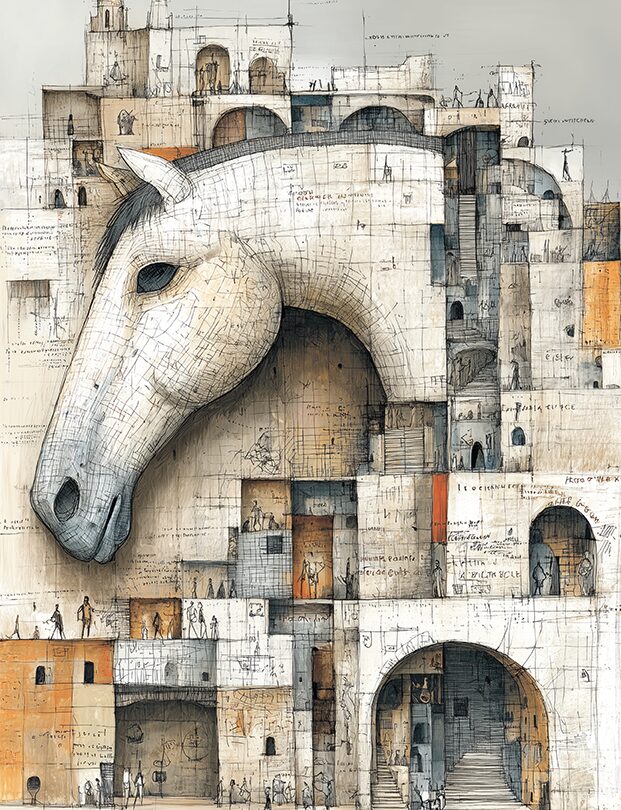
The Odyssey on film is never a simple translation of Homer into images. Every adaptation must decide which Odysseus to show, how much room to give the gods, how to make the creatures visible and what form to assign to the journey. Epic language may leave time, place and proportion open; cinema must build them, light them and allow bodies to move through them.
With The Odyssey, released in cinemas in July 2026, Christopher Nolan returned Homer’s poem to the centre of large-scale cinematic spectacle. Universal’s official site lists 17 July 2026 as the United States release date, while IMAX presents the film as the first feature shot entirely with IMAX film cameras and confirms Matt Damon as Odysseus. This technical choice reveals the intention to turn the voyage into a physical experience of scale, matter, landscape and duration.
Why the Odyssey is difficult to adapt
The Odyssey does not unfold like a modern linear adventure. When the poem begins, Troy has already fallen years earlier. Odysseus is absent from the opening books, and many of his adventures are narrated retrospectively at the court of the Phaeacians. The protagonist is therefore also the narrator of himself. The audience receives not only a sequence of events, but a constructed memory.
Cinema tends to make present what it narrates. When it shows Polyphemus, Circe, the Sirens or Scylla and Charybdis, it reduces certain ambiguities and creates others. A creature that lives in voice, rhythm and the reader’s imagination acquires a precise body. Every visual decision becomes interpretation.
The problem also concerns the structure of the hero. Odysseus is king, warrior, castaway, husband, father, narrator, deceiver and a man trying to return. A film may privilege the commander, the survivor, the man of nostalgia or the agent of Troy’s destruction. No single version contains all the others.
The return begins with war
The voyage to Ithaca cannot be separated from the Trojan Horse. The Odyssey remembers the Horse as the work of Epeius and as the container of the Achaean warriors. Tradition attributes the strategic intelligence of the deception to Odysseus. Before becoming the man who attempts to re-enter his own home, he is the man who enters another city by concealing his presence.
This connection changes the meaning of return. The hero does not merely leave a war behind. He carries the memory of destruction, a victory obtained through deception and the consequences that war continues to produce. The road to Ithaca is also the distance between the victor of Troy and the man who must once again be recognised.
The same cunning reappears at the end of the poem. Odysseus enters his own house under a false identity, observes, measures loyalties and prepares the revelation. The Horse and the homecoming therefore belong to the same grammar: concealment used to cross a threshold.
Christopher Nolan and narrative time
The encounter between Nolan and the Odyssey is especially fertile because his cinema has repeatedly worked with time, memory, identity and the incomplete distribution of information. In his films, audiences understand events through montage, return, overlap and partial knowledge.
Homer’s poem also organises its narrative through uneven times. The present of return contains the past of war; the journey is reconstructed after many trials have already occurred; the final recognition depends on signs belonging to a shared past known only to certain characters.
The interest therefore does not lie in making Homer modern through an artificial structure. The poem already possesses narrative complexity built on memory, stories within stories, concealed identity and delayed knowledge. A contemporary director must decide whether to preserve that complexity or translate it into a more linear progression.
IMAX as a narrative choice
IMAX has stated that The Odyssey is the first feature film shot entirely with IMAX film cameras. The format implies high-resolution images, a powerful sense of scale and a physical relationship with landscape. In the case of the Odyssey, the choice is consistent with a poem in which the human body is repeatedly measured against sea, islands, storms, caves, palaces and creatures.
Monumentality may also alter the myth. An oversized image risks turning every episode into an attraction. The poem depends equally on waiting, loss, hesitation, storytelling and silence. The real challenge is to preserve human vulnerability within the power of spectacle.
Cinematic scale should not merely enlarge the world. It should make perceptible the disproportion between Odysseus and the forces he encounters. The sea is not a background: it is distance, delay, danger and the material of the story.
From oral poem to cinema auditorium
The Odyssey emerged from a culture of voice, memory and performance. Rhythm, recurring formulas and recognisable scenes supported transmission and built a collective experience. Cinema also gathers an audience before a shared sequence, but replaces the imagination evoked by words with a precise audiovisual construction.
This transition is not neutral. The actor’s face becomes the face of Odysseus; a real coastline becomes Ithaca; a creature designed for the film occupies the space the reader might once have imagined freely. Adaptation does not preserve myth in a transparent form. It rearranges it.
Cinema’s force lies precisely in its ability to produce memory. After a widely seen film, many readers return to the poem carrying already formed images. The ancient text is reread through contemporary scenography.
The problem of the Horse on screen
When cinema represents the Trojan Horse, it must solve questions that the story can leave open. How large is it? How do the warriors enter? Where are they positioned? How is it moved? Why should the Trojans consider it credible? How does it pass through the gates?
Every solution produces a different interpretation. A Horse resembling a votive statue emphasises religious value. A massive and rough machine privileges military construction. A structure made from ship timber connects the object to the Achaean camp and the sea. An architectural form turns it into a mobile building, container and monument.
Cinema tends to fix a version. Millions of viewers may come to regard the appearance chosen by a recent production as true, even when it derives from scenographic and narrative requirements. The image progressively replaces the absence of the original.
Odysseus as a contemporary face
Matt Damon plays Odysseus in Nolan’s film. Casting a highly recognisable actor immediately introduces a tension: the mythical character receives a face already charged with cinematic memory. The audience does not encounter a neutral Odysseus, but a body associated with earlier roles, genres and forms of heroism.
This occurs in every adaptation, yet becomes more visible when the project has global prominence. The actor’s face acts as a threshold between ancient myth and contemporary culture. It makes the hero accessible while placing him inside the system of stardom, promotion and media anticipation.
The risk is to reduce Odysseus to an action hero. His strength, however, does not depend only on fighting. It depends on language, deception, narration, self-control and the ability to recognise when force is insufficient.
Myth between fidelity and reinvention
Asking whether a film is faithful to Homer is useful only up to a point. Every adaptation selects, compresses, combines episodes and constructs transitions. The more interesting question concerns the coherence of the new interpretation.
A film may alter details and preserve the poem’s deepest tension. It may also reproduce recognisable episodes and lose the relationship between return, identity, memory and guilt. Literal fidelity does not guarantee fidelity to experience.
Myth continues to live because it tolerates transformation without dissolving. Odysseus may change face, the sea may change geography and the Horse may change structure. Certain forces remain: the desire for return, the seduction of deviation, the limits of intelligence and the cost of survival.
The film as a new stage in the memory of myth
Nolan’s The Odyssey does not close the visual history of the poem. It becomes an especially powerful stage within it. Its production scale, IMAX format and international visibility give many scenes a renewed presence in collective imagination.
This process also concerns the Trojan Horse. Every new cinematic version joins ancient pottery, manuscript illumination, painting, illustration and earlier scenography. Myth does not possess a single image; it possesses a genealogy of images that correct, overlap and forget one another.
In The Trojan Horse — Atlas of a Beautiful Lie, this genealogy becomes the subject of enquiry. The volume does not seek to decide which representation is definitive. It observes how an absent form continues to produce images and how every image modifies the myth it claims to display.
What we see when we see the Odyssey
Cinema makes the voyage visible, but also makes its own period visible. The technologies, bodies, fears and forms of heroism of a contemporary production inevitably enter the ancient world. Every cinematic Ithaca also belongs to the age that constructs it.
The decisive question concerns not only what a film shows of Homer, but what our present seeks in the poem: a hero capable of returning, a measure of loss, an order after war, a home that can still be recognised.
The Odyssey continues to be adapted because return never coincides with mere arrival. It requires a man, a family and a community to recognise what time has transformed.
Essential verified sources
- Universal Pictures, official site for The Odyssey.
- IMAX, official film page and production-format materials.
- Homer, Odyssey.
- Varchi Books, The Trojan Horse — Atlas of a Beautiful Lie.
Continue through the editorial areas
Places and Heritage
Cities, monuments, historic centres and cultural landscapes read as living bodies.
Open editorial areaTerritories and Society
Southern Italy, internal areas, work, school, departures and the right to permanence.
Open editorial areaCare, Family and Recognition
Invisible labour, families, care, generations and forms of recognition.
Open editorial areaMyth, Archaeology and Images
Ancient narratives, visual cultures, myths, deception and the afterlife of images.
Open editorial area