Laocoön and Cassandra: Why Warnings Are Not Enough
An article on Laocoön, Cassandra and the ignored warnings in the myth of the Trojan Horse.
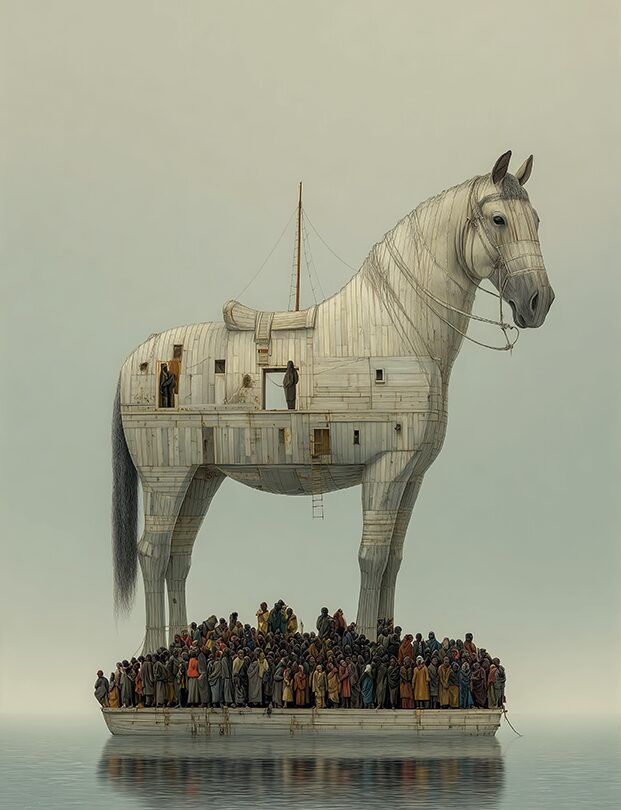
Laocoön and Cassandra see the danger before everyone else. They name it, point towards it and try to stop it. Yet the Trojan Horse enters the city. The myth does not merely narrate the success of a well-constructed deception: it narrates the failure of the correct warning.
The central question is therefore not why nobody spoke. Someone speaks. Someone understands. The problem is why a community cannot receive a truth when that truth contradicts its desire, its symbolic order and the story it has already chosen to believe.
Two figures, two forms of warning
Laocoön and Cassandra do not perform the same role. Laocoön observes the object, formulates suspicion and makes a physical gesture: he strikes the Horse with his spear. Cassandra possesses prophetic knowledge and sees catastrophe before it occurs.
The first speaks as an interpreter of present signs. The second speaks from a position beyond ordinary experience. Both are right, but neither can transform being right into collective decision.
The myth therefore distinguishes two problems: recognising danger and making it credible to others.
Laocoön: doubt before the object
In the most influential Latin version, Book II of the Aeneid, Laocoön urges the Trojans to distrust the Greek gift. His warning begins from a simple rule: an enemy does not cease to be dangerous merely because it changes form.
Laocoön does not rely on words alone. He strikes the side of the Horse with his spear. The object answers with a deep sound. The gesture attempts to turn suspicion into material evidence.
Yet the sign is insufficient. The sound is not recognised as confirmation. The community is already moving towards another interpretation.
Cassandra: truth without access
Cassandra is condemned to know the future without being believed. Her tragedy lies not in ignorance, but in the separation between truth and authority.
For those listening, prophecy possesses no verifiable method. Cassandra knows, but cannot transfer the structure of her knowledge to others. Her message therefore appears excessive, obscure and disturbing.
The myth presents a paradox: complete truth may be less effective than a well-organised lie.
Sinon builds the dominant story
Laocoön and Cassandra do not speak into emptiness. They confront the story constructed by Sinon. The false deserter explains the Achaean retreat, gives the Horse sacred value, anticipates objections and turns its dimensions into favourable evidence.
His version offers the city a legible order. Every element finds a place: the empty camp, vanished ships, abandoned object, Athena’s anger and Troy’s destiny.
The warning introduces disorder. It asks the city to reopen the war at precisely the moment everyone wishes to consider it finished.
The desire for peace as vulnerability
After years of siege, the Trojans do not merely want victory. They want the time of war to end. The Horse arrives when the city is ready to interpret retreat as confirmation of relief.
Laocoön and Cassandra ask the community to surrender that conclusion. Their truth means that danger continues, victory is unreal and the city must distrust even the sign that appears to confirm liberation.
A truth may be rejected because it is uncomfortable. It may also be rejected because it arrives against the emotional time of a community.
Laocoön’s death changes the meaning of signs
When the sea serpents kill Laocoön and his sons, the event is interpreted as divine punishment for the attack upon the Horse. What should increase suspicion becomes confirmation of the object’s sacred character.
A fact possesses no autonomous meaning. It is inserted into the dominant narrative. The same death may be read as the removal of the only man who understood the danger or as the condemnation of the man who offended a holy gift.
The myth shows not only manipulation of facts, but their dependence upon the frame that organises them.
Evidence arrives too early or too late
Laocoön suspects before the Horse is opened. Cassandra knows the result before the city can verify it. Both speak in advance.
This anticipation is their strength and their limit. Fully shared evidence would arrive only after the nocturnal opening, when it would be useless. Before that moment, every warning must compete with uncertainty.
Prevention always operates within this difficult zone: it must make credible a harm that has not yet occurred.
Being right does not mean persuading
The myth clearly separates correctness from persuasion. Laocoön and Cassandra possess the right conclusion. Sinon possesses the more effective form.
Persuasion depends upon tone, role, desire, authority, ritual and the ability to offer a coherent story. Truth, when it cannot construct a communicable form, may remain isolated.
This distinction does not justify deception. It requires us to recognise that truth needs languages, evidence and relationships capable of circulation.
The problem of reputation
Every warning is also judged through the person who issues it. Cassandra carries the reputation of a voice that cannot be believed. Laocoön enters into conflict with the religious order constructed around the Horse.
Sinon, by contrast, appears as a victim. His apparent weakness generates trust. The city does not evaluate words alone; it evaluates the social and symbolic position of the speaker.
Credibility is therefore not identical with real competence. It may be distributed unjustly.
When the group protects its decision
Once the Horse begins moving towards the city, reversal becomes harder. Men, ropes, rituals and celebration transform a hypothesis into collective action.
Every further gesture increases the cost of reconsideration. To admit danger would mean recognising that victory is incomplete, the ritual mistaken and the community involved in producing its own vulnerability.
The warning no longer confronts an idea alone. It confronts an action already under way.
The city hears what confirms its self-image
The Horse offers the Trojans a desirable image of themselves: a city capable of surviving, winning and appropriating the enemy’s symbol.
Laocoön and Cassandra offer the opposite image: a city still vulnerable, unable to recognise deception and forced to continue living with suspicion.
Communities defend more than interests. They defend identity narratives. A warning is rejected when it threatens the way a group wishes to see itself.
From ancient myth to contemporary risk
The structure returns in health, environmental, financial, technological and political crises. Early warnings are often treated as excessive until damage becomes visible.
Experts may identify vulnerability, but public decisions depend upon interests, timing, institutional trust and the ability to communicate uncertainty. A message that is too absolute may appear alarmist; one that is too cautious may fail to produce action.
The myth of Laocoön and Cassandra offers no universal technique. It reminds us that a warning must cross a social threshold, not merely be correct.
Laocoön in the history of images
The Laocoön sculptural group transformed warning into a body. Muscular tension, pain, serpents and resistance make visible the moment when knowledge can no longer save itself.
The work does not show the Horse directly. It shows what happens to the man who attempts to prevent its entry. The threat remains outside the frame, yet determines every gesture.
This absence increases the force of the image. The Horse becomes present through the destruction of the voice that recognised it.
Cassandra and the image of the broken voice
Cassandra has been represented as prophet, captive, victim and figure of denied knowledge. Her story continues beyond the Horse, through Troy’s destruction and the violence that follows.
Her voice fails not because it is uncertain. It fails because the community no longer possesses a place in which that voice can be recognised.
The myth thus connects catastrophe with the loss of a possible form of listening.
The Horse as a device that neutralises warnings
The Horse is effective not merely because it conceals men. It is effective because the system built around it weakens every warning.
Sacred form discourages inspection. Sinon’s story anticipates doubt. The desire for peace reduces caution. Laocoön’s death is interpreted against his own message. Cassandra speaks from a position already deprived of authority.
Perfect deception does not eliminate those who see. It makes seeing insufficient.
The relationship with Atlas of a Beautiful Lie
The Trojan Horse — Atlas of a Beautiful Lie explores the relationship among form, gaze, symbol and credibility. The Horse repeatedly changes appearance, yet preserves its capacity to organise what may be seen and what remains concealed.
Laocoön and Cassandra belong to this problem of vision. They see beyond the surface, but cannot alter collective perception.
The atlas does not seek only the image of the object. It also seeks the conditions that make an image stronger than a warning.
Why warnings are not enough
Warnings are insufficient when they arrive against a dominant desire, when the speaker lacks credibility, when facts are interpreted within an established narrative and when a community has already invested in the opposite decision.
Laocoön and Cassandra do not prove that speaking is useless. They show that truth must find a form capable of being heard before danger becomes irreversible.
Their failure does not belong only to Troy. It concerns every community that confuses relief with safety and the coherence of a story with the truth of events.
Essential sources
- Virgil, Aeneid, Book II.
- Ancient traditions concerning Cassandra and the fall of Troy.
- Varchi Books, The Trojan Horse — Atlas of a Beautiful Lie.
Continue through the editorial areas
Places and Heritage
Cities, monuments, historic centres and cultural landscapes read as living bodies.
Open editorial areaTerritories and Society
Southern Italy, internal areas, work, school, departures and the right to permanence.
Open editorial areaCare, Family and Recognition
Invisible labour, families, care, generations and forms of recognition.
Open editorial areaMyth, Archaeology and Images
Ancient narratives, visual cultures, myths, deception and the afterlife of images.
Open editorial area