How Many Warriors Were Hidden Inside the Trojan Horse?
An article on the number of warriors hidden inside the Trojan Horse and the variants of the ancient tradition.
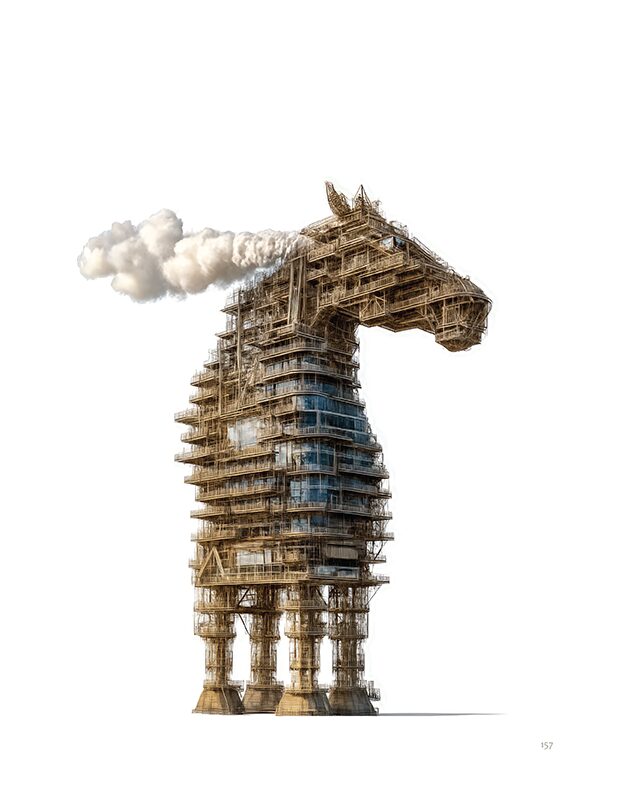
How many warriors were hidden inside the Trojan Horse? The question appears technical, almost geometric. In fact, it opens a problem of sources. Ancient texts do not agree on the number, preserve no single list and describe no definitive construction design. The Odyssey recalls that the Horse was filled with the men who would destroy Troy, but gives no precise figure.
Later versions add different names, quantities and details. The most rigorous answer is therefore that no single historically verifiable number exists. Depending on source and reconstruction, tradition ranges from relatively small groups to much larger contingents.
The essential answer
Homer does not state how many men were hidden inside the Horse. In Book VIII of the Odyssey, Demodocus sings of the wooden Horse made by Epeius with Athena’s help, led by Odysseus into the citadel and filled with the men who would sack Ilios. The text preserves the core of the episode, but not a complete list.
Virgil, in Book II of the Aeneid, speaks of selected warriors concealed within the timber body. Here again narrative value matters more than numerical detail. The essential point is that the group is large enough to open the city from within and enable the Achaean army to return.
Later authors attempt to name the participants. Quintus Smyrnaeus, in the Posthomerica, supplies a long list and states that as many leading warriors entered as the carved Horse could hold. The formulation already reveals the problem: capacity is adjusted to narrative tradition.
Why the sources disagree
The Trojan myth did not belong to one book. The Iliad, the Odyssey, the lost poems of the Epic Cycle, tragedy, the Aeneid and late-antique works selected different episodes and characters.
Each author wrote for a different audience, language and purpose. A catalogue of heroes might connect genealogies, honour local traditions or increase the solemnity of the enterprise. A shorter account might mention only the principal names.
Variation is not an error waiting to be corrected. It is the manner in which myth was transmitted.
The list in Quintus Smyrnaeus
In Book XII of the Posthomerica, written in late antiquity, Quintus Smyrnaeus narrates the construction of the Horse and names many of the heroes who enter it. They include Neoptolemus, Menelaus, Odysseus, Sthenelus, Diomedes, Philoctetes, Menestheus, Anticlus, Thoas, Polypoetes, Ajax, Idomeneus, Meriones, Teucer, Demophon and Acamas.
The list should not be treated as a military register. It is a poetic construction later than the Homeric epics and participates in the desire to complete narratively what earlier texts left open.
Quintus also adds an important architectural detail: Epeius enters last because he knows the secret of the doors and the opening system. The builder is not merely responsible for the envelope; he controls its internal operation.
Thirty, forty, fifty: where the numbers come from
Modern summaries circulate different figures, often ranging from roughly thirty to fifty men. These numbers arise from combining ancient lists, later traditions and editorial counting. They are sometimes presented as certain facts, but do not possess equal authority.
One list may count only named heroes; another may include unnamed companions. Some narratives imagine a small elite group, while others imply a force large enough to sustain fighting inside the city.
The number also changes with the assigned mission. Must the men only open the gates? Must they occupy strategic points? Must they fight until the fleet returns? Each answer produces a different capacity.
The problem of scale
As soon as a number is assigned, the Horse acquires dimensions. Thirty armed men require space for bodies, shields, weapons, movement and waiting. A larger contingent makes the object enormous, heavy and difficult to draw.
The issue concerns more than internal volume. The structure must carry loads, provide entry, allow exit, offer ventilation, preserve silence and distribute weight.
Myth supplies no construction drawing. Every modern reconstruction must invent what the sources leave undefined.
How much space does a warrior occupy?
A motionless body occupies relatively little space; an equipped warrior requires much more. He must breathe, shift position and reach the exit. Weapons cannot be placed at random. A collision, fall or noise could reveal the group.
The long wait intensifies the problem. The warriors enter before the Horse is drawn into the city and remain concealed during debate, movement and celebration. Time turns the container into an environment.
The Horse is therefore not a simple box. It is an inhabited space under extreme conditions.
A structure that must appear to be something else
The object must be large enough to contain men and credible enough to be read as a votive gift. This double requirement creates a design tension.
If it appears too functional, it may resemble a military machine. If too fragile, it cannot carry the load. If too large, it becomes difficult to move and pass through the walls. If too small, the hidden group loses effectiveness.
The design must conceal military rationality within symbolic form.
Epeius inside the Horse
Tradition assigns construction to Epeius. In Quintus Smyrnaeus, he enters last, draws up the ladders and positions himself beside the locking mechanism. The detail gives the builder an operational responsibility.
The hidden door is the decisive threshold of the device. It must remain invisible from outside, withstand transport and open quickly from within.
The success of the deception therefore depends on a technical element unseen by the public.
Why Odysseus must be inside
Odysseus does not merely devise the plan. Sources place him inside the Horse with the other warriors. His presence maintains control, discipline and strategic coherence.
In the Odyssey, Helen recalls approaching the Horse and imitating the voices of the Achaeans’ wives. Anticlus wished to answer, but Odysseus prevented him. The detail reveals how completely the operation depends on control of sound and reaction.
The Horse contains armed men, but above all men compelled not to act until the correct moment.
Silence as a construction component
A structure filled with warriors produces creaks, breath, impacts and movement. Myth asks us to imagine an almost impossible discipline. Silence becomes part of the design.
It is insufficient to hide bodies from sight. They must also be hidden from hearing. The envelope must absorb or confuse noise, while the men control fear, exhaustion and impulse.
The machine of deception works through what it prevents others from perceiving.
Opening the gates, not conquering the city alone
The hidden group need not defeat all of Troy by itself. Its main function is to emerge, neutralise guards, open access points and signal the fleet to return.
This mission makes a relatively limited contingent plausible. The Horse carries an infiltration force, not the entire army.
The city falls because a small group changes the relationship between inside and outside. Position matters more than quantity.
The walls as a reversed problem
For ten years, the walls separate the Achaeans from the city. The Horse does not overcome them through assault: it persuades the Trojans to carry the attackers across the threshold.
Once inside, even a few men can achieve what thousands outside could not. Myth turns the fortification into a trap: the walls protect the enemy already admitted.
Deception does not abolish defensive architecture. It reverses its operation.
Why the number still interests us
Counting the men means searching for a point of reality inside myth. Number seems to promise a verifiable measure: if capacity were known, volume, height and structure might be reconstructed.
Yet the technical question meets a mobile tradition. Every figure produces a different Horse and a different interpretation of the operation.
Uncertainty does not prevent reconstruction. It requires reconstruction to be declared as interpretation.
The Horse as architectural section
To represent the Horse in section is to reveal what myth wishes to conceal. A section displays bodies, levels, ladders, supports and mechanisms. It transforms the icon into constructed space.
In cinema, illustration and three-dimensional models, this operation is unavoidable. Every author decides how to arrange the men, open the body and support the load.
The section does not discover archaeological truth. It produces a coherent version.
From number to metamorphosis
The Trojan Horse — Atlas of a Beautiful Lie does not seek a definitive capacity. The volume explores the Horse as body, matter, project, architecture and city.
Every metamorphosis implicitly changes the interior. A relic-Horse, building-Horse, city-Horse or machine-Horse contains different presences.
The question ‘how many men?’ becomes broader: what must a form contain in order to remain recognisable as the Trojan Horse?
The final answer
We do not know one definitive number of warriors hidden inside the Trojan Horse. The Odyssey provides no figure; Virgil speaks of selected men; later traditions supply different lists. Modern reconstructions often imagine several dozen participants.
The most rigorous answer is not to select a number arbitrarily. It is to recognise that every figure belongs to a version of the myth and determines a different architecture of the Horse.
Essential verified sources
- Homer, Odyssey, Books IV and VIII.
- Virgil, Aeneid, Book II.
- Quintus Smyrnaeus, Posthomerica, Book XII.
- Fragments and summaries of the Epic Cycle.
- Varchi Books, The Trojan Horse — Atlas of a Beautiful Lie.
Continue through the editorial areas
Places and Heritage
Cities, monuments, historic centres and cultural landscapes read as living bodies.
Open editorial areaTerritories and Society
Southern Italy, internal areas, work, school, departures and the right to permanence.
Open editorial areaCare, Family and Recognition
Invisible labour, families, care, generations and forms of recognition.
Open editorial areaMyth, Archaeology and Images
Ancient narratives, visual cultures, myths, deception and the afterlife of images.
Open editorial area