Did the Trojan Horse Really Exist? History, Myth and an Absent Form
An article on the Trojan Horse between history, myth, ancient sources and the most famous image of deception.
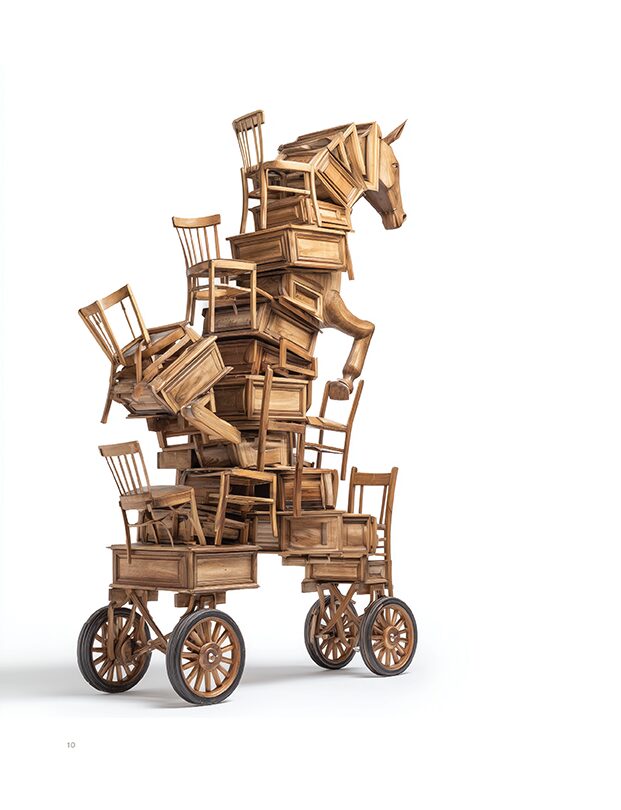
The Trojan Horse is one of the most recognisable objects in Western culture and, at the same time, one of the least verifiable. We see it immediately: a huge wooden animal mounted on wheels and drawn through the gates of a city. We know that warriors are hidden inside. We know the outcome before the story has properly begun. Yet no one can point to its original appearance, its dimensions, its exact material, the number of men concealed in its body, or any archaeological evidence capable of confirming that it existed.
The question ‘Did the Trojan Horse really exist?’ seems to require a simple answer. In fact, it opens at least three separate problems: the existence of Troy, the possible historical basis of a Late Bronze Age war, and the material reality of the Horse. The first two belong to archaeological and historical research; the third remains within the territory of literary tradition, hypotheses and images.
Troy existed: the Horse is another matter
The archaeological site at Hisarlık in north-western Türkiye preserves a long sequence of settlements built one above another. Excavations have shown that Troy was not a city invented from nothing: the place was inhabited for millennia and occupied an important position in the relationships between Anatolia, the Aegean and the Balkans. UNESCO attributes roughly four thousand years of history to the site and recognises its settlement sequence as fundamental to the understanding of the civilisations of the region.
This archaeological reality does not prove that the war preserved in tradition unfolded exactly as the poems describe it. The ruins document cities, destruction, rebuilding, fortifications and exchange. They do not return Helen, Achilles, Odysseus or the Horse. Between a real city and an epic narrative lies a space that cannot automatically be closed.
Memories of Bronze Age conflicts may have entered the Trojan tradition. Events, people and strategies belonging to different periods may also have been assembled into a single great narrative. Caution is essential: a plausible historical basis does not turn every element of the myth into a demonstrated fact.
The Horse does not end the Iliad
One of the most common misunderstandings concerns the source of the story. The Iliad does not end with the Trojan Horse and does not narrate the fall of the city. The poem closes with Hector’s funeral. The Horse belongs to the tradition that follows the central action of the Iliad and emerges through several texts, including the Odyssey, fragments of the Epic Cycle and, in the version that became especially influential in European culture, Book II of Virgil’s Aeneid.
In the Odyssey, the Horse is remembered as the work of Epeius and as the container of the Achaean warriors. The object appears within stories and recollections: it is already a transmitted image, a scene sustained by words. Tradition credits Odysseus with the strategic conception and Epeius with its construction. The distinction matters, because the Horse is born from the union of two forms of intelligence: the narrative and military mind that devises the deception, and the technical mind that gives it a credible body.
An object that works because it is narrated
The Horse alone would not be enough. For it to be taken into the city, it requires an explanation. Tradition gives Sinon the task of making the object abandoned by the Achaeans believable. The gift must appear sacred, dangerous to reject and favourable to Troy. The physical machine is therefore protected by a narrative machine.
This is one reason why the myth remains current. The most effective deception does not force its victim to submit to an intrusion: it persuades the victim to grant access. The Trojans do not merely see an object. They see the end of the siege, the enemy’s retreat, a religious sign and the chance to turn the monument of their opponents into the trophy of their own victory. The Horse enters because it answers what the city wishes to believe.
Laocoön and Cassandra represent the opposite side of the story. Both perceive the danger, yet neither can prevent the community from accepting the object. The problem is not the absence of a warning. It is the warning’s inability to compete with a more seductive form and a more desirable story.
What might the Trojan Horse have been?
Many hypotheses have been proposed. The Horse may preserve a memory of a siege engine, a battering ram or a mobile structure used to cross or damage the walls. It may retain the memory of a ship: in some ancient cultures the horse was symbolically connected with the sea, and nautical language may have encouraged later transformations. Other readings connect the episode with an earthquake, since the horse was associated with Poseidon, or with a votive offering intended to make the abandonment of the Achaean camp credible.
None of these proposals has produced conclusive evidence. They are attempts to translate the myth into a plausible mechanism. They may illuminate individual aspects, but become misleading when presented as the definitive solution. The story may have compressed different events; the Horse may be a poetic form created through the fusion of military memory, religious symbolism and narrative necessity.
Even if a real siege device lay behind the tradition, it would not necessarily coincide with the giant wooden animal familiar to us. The movement from a possible historical mechanism to the icon we recognise is already a metamorphosis.
Why have no remains been found?
The absence of remains does not by itself prove that the Horse never existed. A wooden object exposed to fire, destruction, reuse and decay for more than three thousand years would have little chance of surviving. Yet this observation cannot be reversed into evidence: the possibility that an artefact disappeared does not allow us to assert that it existed.
Archaeology works with materials, stratigraphy, contexts and comparison. So far, it has not produced an object identifiable as the Trojan Horse. It has produced something different and perhaps more important: the complex reality of Troy, its long duration, and the unstable relationship between the excavated city and the city imagined by literature.
A form without an original
The lack of a verifiable original has released an extraordinary number of images. Each period has been able to construct its own Horse. Ancient representations differ from medieval ones; manuscript illuminations reshape it according to the technologies of their time; painting makes it monumental; cinema must decide its proportions, structure, entrances and movement. Even when artists seek plausibility, they are choosing among possibilities rather than copying a certain model.
This is where the Horse becomes an exceptional case in visual culture. Its identity does not depend on fidelity to an artefact, but on the repetition of a few minimum elements: an equine form, a hollow body, a hidden presence, entry into the city and a nocturnal opening. Everything else can change.
The myth survives because it offers a structure stable enough to be recognised and incomplete enough to be reinvented. Absence does not weaken the image; it makes the image productive.
The Horse as architecture
Seen through architecture, the Horse is far more than a sculpture. It has an exterior and an interior; it organises a threshold; it contains bodies; it must support loads; it moves through space; it alters the relationship between outside and inside the city. Its animal façade promises one thing, while its internal space prepares another.
It is a mobile and clandestine building. Its effectiveness depends on the separation between what it displays and what it houses. In this sense it anticipates a figure that will recur throughout history: the acceptable envelope containing a programme incompatible with its appearance.
The Horse enters the city as a monument and opens as military infrastructure. The decisive threshold is not only the gate in the walls. It is the object’s surface, the boundary that prevents the inhabitants from seeing its contents. The deception is spatially constructed.
From myth to the contemporary trojan
The word trojan entered computing because it preserves this logic. A program or file appears legitimate, useful or desirable; once accepted, it enables a concealed action. The metaphor does not repeat every detail of the myth, but keeps its structure: access obtained through a reassuring form.
The same pattern reappears in propaganda, advertising, politics and digital communication. A proposal is accepted for what it claims to be, while its actual effect emerges after it has crossed the threshold. To call something a ‘Trojan horse’ is to recognise that danger requires the cooperation of those who welcome it.
What, then, can history say?
The most rigorous answer is this: Troy is a real archaeological site; conflicts in the region are historically plausible; the Horse belongs to an ancient and widely attested tradition; its material existence has not been demonstrated. Interpretations of it as a machine, ship, religious symbol or memory of a natural event remain hypotheses.
This conclusion does not diminish the myth. It makes it more interesting. The Horse matters not only for what it may have been, but for what it has continued to become. Every reconstruction also describes the period that produces it: its technologies, its way of imagining war, its relationship with evidence and its trust in images.
An atlas of the absent form
The Trojan Horse — Atlas of a Beautiful Lie begins precisely from this absence. The volume does not present its artefacts, museums and attributions as real archaeological documentation: it declares a documentary fiction and uses it to explore the visual persistence of the myth. Images become possible variations; the atlas does not seek the single true form, but observes how each form produces a different truth of deception.
The book passes through the Horse as root, symbol, shadow, face, idea, project, matter, metamorphosis, architecture, city, exodus, gaze and relic. This structure suggests that the object belongs to no single field. It is story and construction, container and image, memory and artifice.
By the end, the opening question has shifted slightly. We no longer ask only whether the Horse existed. We ask how it became so visible without leaving an original, and why we continue to recognise it even as its material, period and language change.
Essential verified sources
- UNESCO World Heritage Centre, Archaeological Site of Troy.
- Homer, Odyssey, Book VIII.
- Fragments of the Epic Cycle, including the Little Iliad and the Iliou Persis.
- Virgil, Aeneid, Book II.
- British Museum materials for Troy: Myth and Reality.
Continue through the editorial areas
Places and Heritage
Cities, monuments, historic centres and cultural landscapes read as living bodies.
Open editorial areaTerritories and Society
Southern Italy, internal areas, work, school, departures and the right to permanence.
Open editorial areaCare, Family and Recognition
Invisible labour, families, care, generations and forms of recognition.
Open editorial areaMyth, Archaeology and Images
Ancient narratives, visual cultures, myths, deception and the afterlife of images.
Open editorial area